
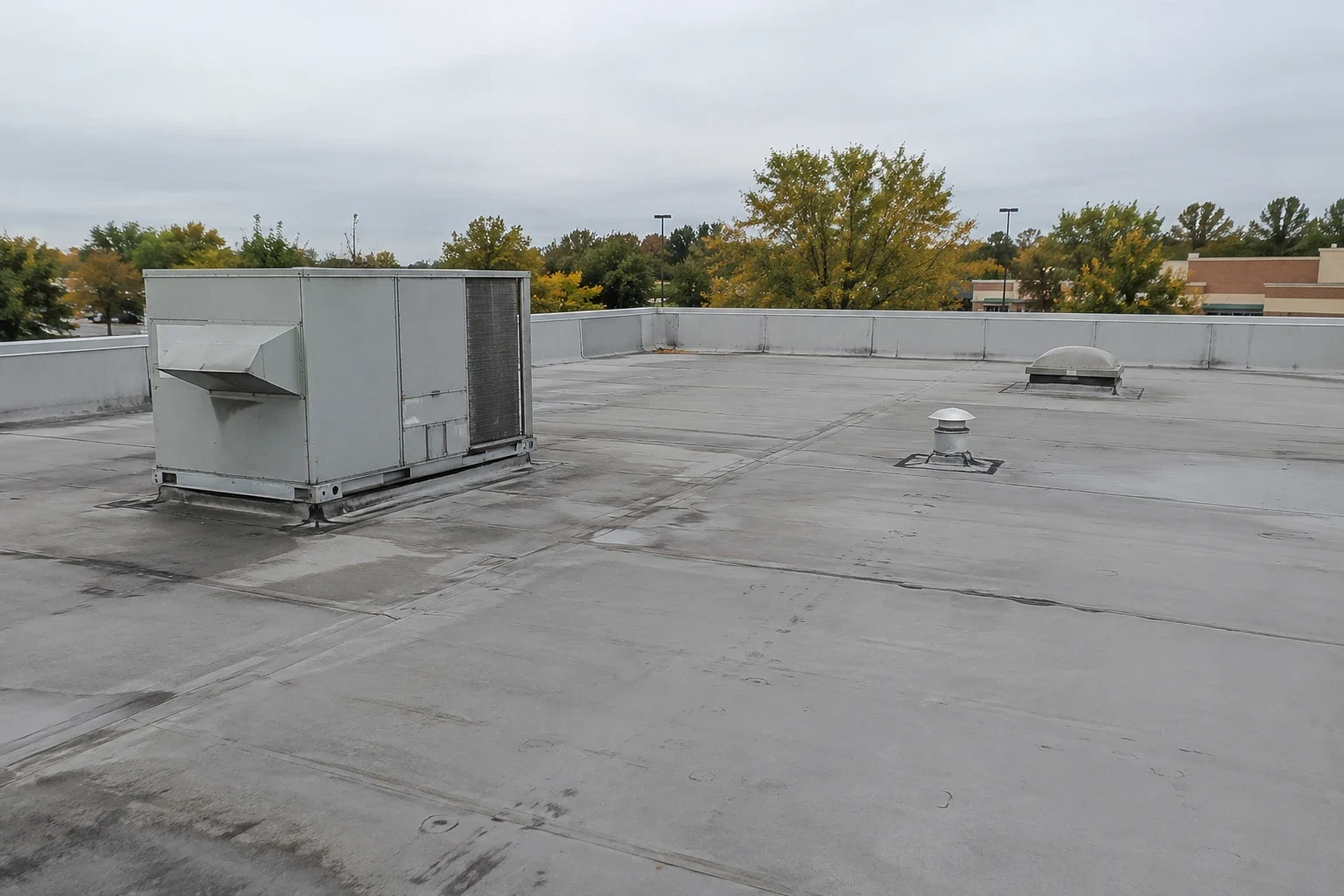
Commercial Roofing for Cambridge Retail and Restaurant Chains

Coordinate Cambridge retail and restaurant roof repairs around opening hours, customer routes, kitchen equipment, drainage, and section-level closeout records.
A shared parapet above adjacent shops can direct runoff toward one storefront while the interior report points to a different bay. For Cambridge retail and restaurant chains, we map that report to the roof section, inspect connected details, and coordinate around customer hours and deliveries. CambridgeSide has two levels of shops and restaurants in East Cambridge. Alewife also has shopping centers along Alewife Brook Parkway, and Harvard Square is a pedestrian-oriented retail district. These are different operating settings; none tells us the assembly or condition at a specific tenant space.
What should a store or restaurant roof check include?
We inspect membrane seams, drains, curbs, kitchen exhausts, refrigeration supports, skylights, parapets, and perimeter metal near the reported condition. A ceiling stain may be offset from the roof entry, so we compare it with slope and penetrations rather than opening directly above the interior mark. Where the roof is shared with neighboring tenants, we label the unit and section boundary and note whether another owner controls part of the assembly. Moisture testing may be needed before a repair area can be confirmed.
CambridgeSide lists a mix of shops, food, and beverage uses, while Alewife’s corridor has retail stores and roadway access. The district context can help plan deliveries, but the property manager confirms the loading door and exhaust layout. A roof condition survey records the roof area and finding. A kitchen-equipment curb review checks the flashing around exhaust and refrigeration supports. If a drain is near the unit line, a drainage check traces the primary outlet and overflow.
How can service stay open while roofing work proceeds?
The operator identifies opening and closing hours, food-service or retail deliveries, customer entrances, outdoor seating, roof access, and the areas below the planned section. We coordinate material lifts and barriers against those routes and set a daily roof closure point. If the surface needs a larger opening than expected, we stop at a safe boundary, record the condition, and confirm the revised area with management before continuing.
Harvard Square combines retail, university, restaurants, bookstores, theaters, and transit, while the Alewife district relies on roadway and Red Line connections. These conditions may affect delivery windows, but the chain’s local manager provides the route for the specific store. An occupied-store sequence can phase noisy work and roof openings around service hours. At a CambridgeSide property, the building contact confirms loading access, lift staging, and any mall coordination.

What should happen when water reaches a dining or sales area?
We document which area is affected, check the roof section above, and trace seams, curbs, edges, and drainage before assigning the cause. A leak over a kitchen may involve exhaust flashing, piping, or condensation, so we compare roof evidence with the equipment layout. If water is active, emergency service can be coordinated at any hour, including holidays, once site access is approved. The first visit locates and protects the opening when safe, then records any testing needed for permanent repair.
Cambridge winter guidance describes heavier precipitation and more frequent flooding along with changing freeze-thaw conditions. Those patterns make outlets and overflows important to check, but a weather trend is not a diagnosis for a tenant space. The field report separates temporary stabilization from completed repair and notes whether any adjacent suite was inspected. A store operator can then coordinate interior protection without assuming that neighboring units share the same roof condition.
Can the chain repair a storefront roof one unit at a time?
A single tenant bay may have a repairable seam or curb failure, but the roof can continue over several units. We identify who controls the membrane, which sections were inspected, and whether a repair crosses a lease boundary. A recover depends on attachment, moisture, layer count, drainage, and clearances; replacement brings removal, debris routing, and broader tenant coordination. We state those limits so one location’s finding does not become a portfolio-wide replacement assumption.
A property manager can coordinate building access, while a hospitality group may schedule around guest arrivals. Retail and dining chains also need opening-hour and food-service controls. A recover assessment records the roof layers and tests. A replacement scope names the units, common roof area, and temporary protection included in the project.
What helps a chain compare roofs across locations?
A shared reporting format can record address, roof section, material observed, drains, equipment curbs, open findings, and next action. It does not imply that every site uses the same assembly. We identify work that is complete, temporary, or awaiting testing so operations staff can match the record to the store. When a lease or building ownership changes, the section labels and contact notes help preserve the maintenance history.
CambridgeSide and the Alewife shopping corridors have different tenant and access settings. For a chain with more than one local property, we can keep repair photos and dates tied to each address and compare only the documented condition. A multi-site roof schedule can organize inspection and follow-up dates. A Harvard Square location still receives its own access and staging review before work begins.
When a landlord controls the common roof, the chain’s store manager should keep the property contact and maintenance number with the unit records. That handoff helps route a future leak report to the party responsible for roof access and prevents a tenant repair from being mistaken for work on the shared assembly.
What should the store manager receive?
Closeout identifies the store, roof section, repair detail, equipment transition, test point, photos, and access limits. If temporary protection remains, we mark its location and follow-up status. We also state which roof area was not opened or tested. This record helps the chain’s facilities lead tell whether an issue at one storefront was resolved or whether the next inspection must include a different section.
The next service visit can compare the same curb, drain, or seam with dated images. Cambridge’s storm and winter guidance makes those drainage notes useful in seasonal planning, while a fresh inspection establishes current condition. The handoff gives store operations a clear contact, work boundary, and reopening status without treating the chain’s other locations as equivalent.
The store handoff identifies which entrance, kitchen, sales area, or loading zone was affected and when the roof section above it was closed. We note any change to customer access, delivery timing, or equipment operation that remained in effect at the end of the shift. A regional manager can use common status labels across locations, but each store record needs its own repair photographs and authorized contact. If a ceiling stain returns, staff can compare its location and date with the prior roof work rather than assume the same patch failed. Any new water report triggers a fresh inspection of the connected roof details.
Commercial Roofing Questions
Can roof repairs happen after a store closes?
The manager can provide closing hours, delivery windows, and access restrictions. We plan the work and daily weather closure around those limits when conditions and the approved scope permit.
How do you handle a leak that crosses a tenant boundary?
We map the roof section and unit line, inspect the relevant area, and note which party controls the assembly. The scope identifies the areas inspected and any access still needed.
Can a restaurant stay open during exhaust-curb work?
The operator and property contact identify kitchen schedules, air-intake controls, and customer routes. We coordinate the work boundary and any temporary closure before mobilization.
Will one Cambridge store’s roof report apply to another?
No. Each property gets its own system and condition record. Portfolio reporting can use consistent labels while keeping findings tied to the address inspected.
What information should a chain provide before an inspection?
Send the store address, roof plan or service record, reported condition, kitchen or delivery hours, property contact, and access rules. We verify the assembly and repair limit in the field.
Related Roofing Work
More Industries We Serve
Browse every page in Industries We Serve, or request a roof assessment and we will walk the roof with you.
Schedule roofing around store operations
Send the Cambridge store address, roof plan and service history, reported condition, opening and delivery hours, property contact, and preferred work window. We will map the roof section and work sequence.